
Review: Macbeth: The Scottish Play opens in Bristol
By Georgia Knowlden, Volunteer
Tobacco Factory Theatres’ in house production of Macbeth, proudly supported by Clifton College, is running until 28th March 2026 and is a dark exploration of humanity which demands to be seen.
Shakespeare’s Scottish tragedy unfolds within the theatre-in-the-round shrouding of The Factory, one of Tobacco Factory Theatres’ two dynamic performance spaces. Seated on all sides, the audience doesn’t observe Macbeth’s own unravelling from safe remove, instead we are placed eerily within it. The space privileges you either to catch a flash of guilt or a whispered aside, or to experience the playwright’s words from concealed utterance, depending on where the actor’s gaze is cast. In this dark arena, there is nowhere to hide, and crucially, neither is there anywhere for the characters to hide themselves.
Such a space reframes the Jacobean text so intimately that audience members take on the role of witness. Macbeth, a play about complicity and the silence of those who watch violence escalate, thrives within a space where guilt is afforded little space to go.
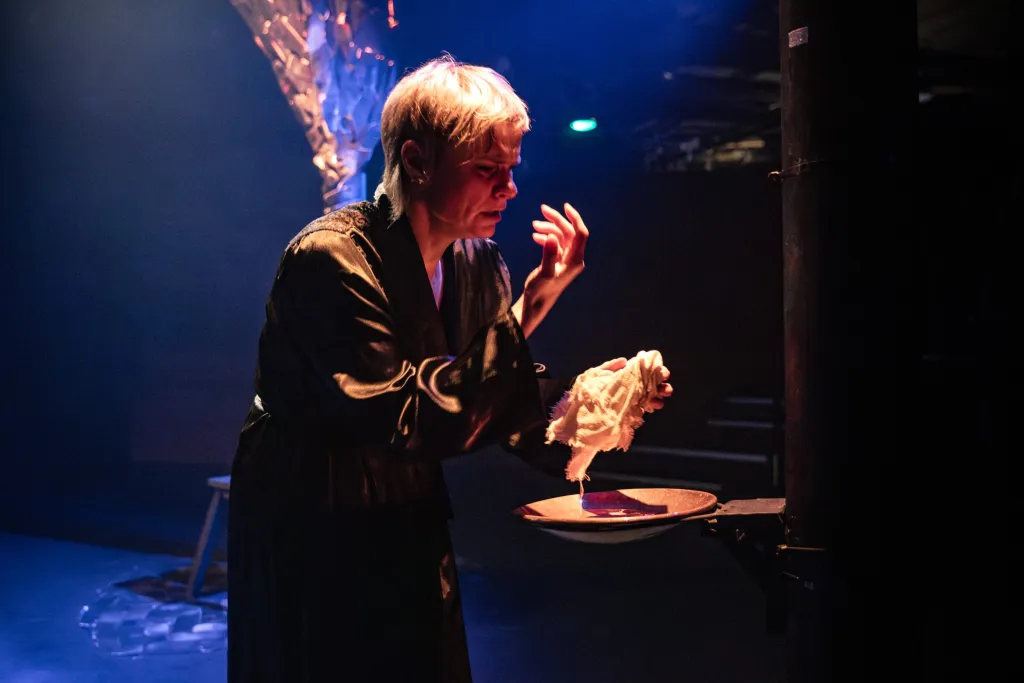
The staging is deliberately and brilliantly spare, until moments when it is so suddenly not, and unfurls a banquet, a battle or a throng of witches, then moments later dispersed again. When the set is bare it is so because it rightfully trusts in the decadence of the company’s performances accompanied by dark pagan undertones and soundscape. In a play where blood isn’t rinsed off so easily, a basin that taunts from the edge of the stage is the standout object of anxiety as it is charged with meaning whenever it is neared.
The wardrobe follows the same principle. Contemporary costumes in sombre tartans and argyles evoke a realm somewhere between the ancient and the immediate. As the narrative bleeds so do their wounds, and the bloodstaining of fabric becomes its own quiet record of what has been done and cannot be undone. And then there is the crown, passed, seized, worn and lost, tracing the arc of the play’s ambition and despair.
The weight of the tragedy is carried by ten actors, all with roots in Bristol, some multi-roling, some singing, all dancing, and Vaughan’s ensemble-led approach is evident in every scene. The movement work is exceptional. Fight sequences are precisely choreographed without ever feeling mechanical and you can feel the shared rhythm of the company, which thrusts along Shakespeare’s fastest-paced tragedy.
One cannot omit the witches from an account of the play. Cloaked and concealed, their scenes pulse with choreographic intelligence. Their prophecy arrives from behind us and floods down onto the stage, where in the centre of the round stands Macbeth, encircled. It is a quietly devastating staging choice, capturing in spatial terms what the play tells us in language: that the ‘instruments of darkness’ speak not from some remote supernatural plane, but from the walls of a space we all agreed to enter.
Director of the show, Heidi Vaughan describes Macbeth as a play that ‘never really loosens its grip’, and this production earns that description in its fast and physical, yet never reckless, throws. In Vaughan’s words, a company that has built ‘a shared language, rhythm, and responsibility’ brings collective energy to a production that is close, current and renders The Factory’s confines an honest and unsparing space.
Find out more about the play here: https://tobaccofactorytheatres.com/shows/macbeth-3/
Image credits: Craig Fuller